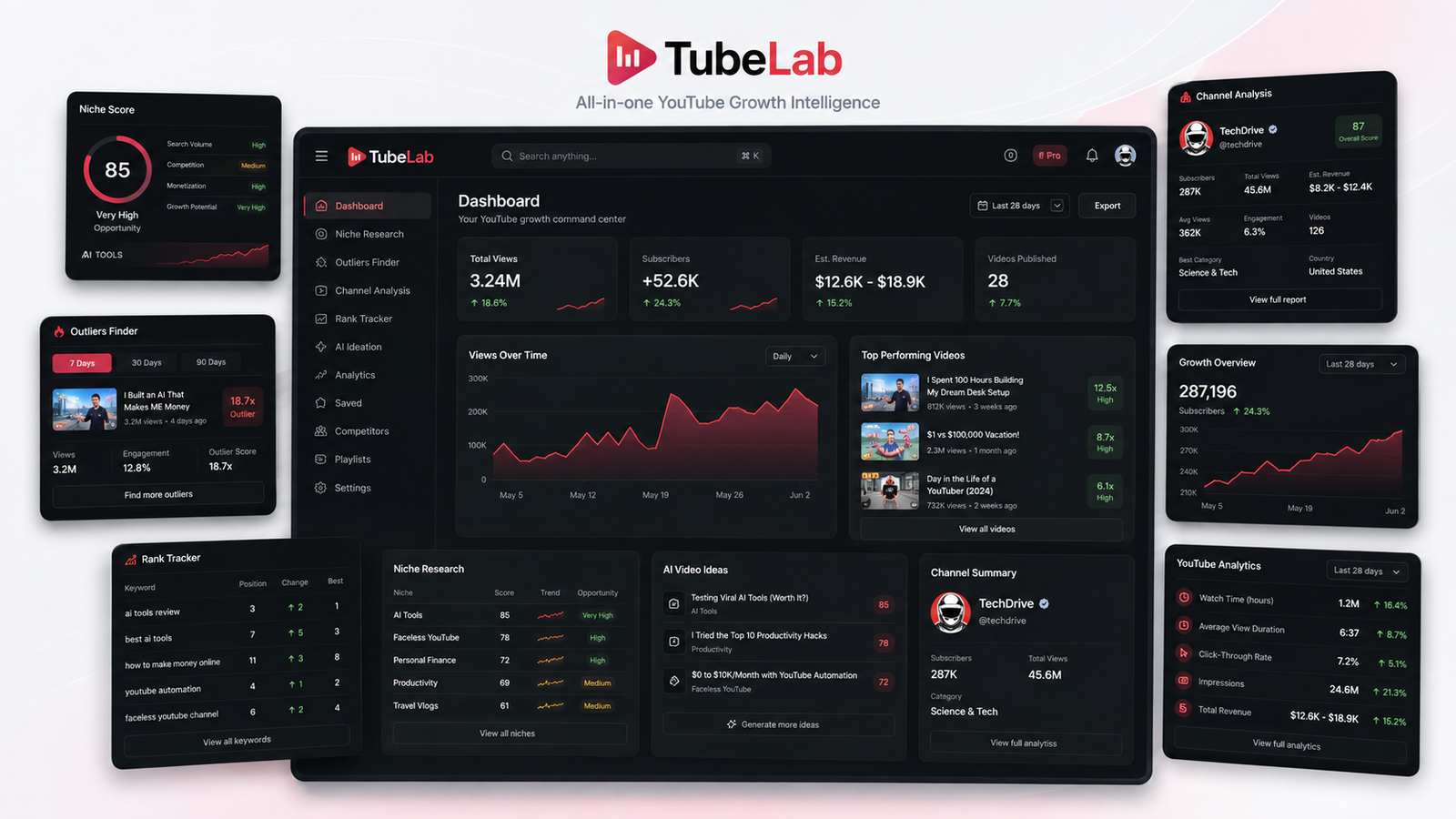
BUY — TubeLab is a strong buy for creators who perform structured YouTube research every week and can turn better niche and outlier data into original content decisions.
TubeLab combines Niche Finder, Outliers Finder, Trending Formats, AI ideation, Niche Analyzer, Rank Tracker, free tools, MCP, API, and n8n automation for data-led YouTube planning.
Best forYouTube creators, faceless-channel operators, strategists, agencies, researchers, and developers building content intelligence workflows.
Think twice ifYou only need basic channel analytics, upload checklists, occasional keyword ideas, or guaranteed revenue forecasts.
Table of Contents
How the tool fits real work
Discover opportunities
Filter rising channels and niches by performance, estimated RPM, revenue, monetization, language, and other signals.
Study what breaks out
Inspect outlier videos, titles, thumbnails, competitors, and similar formats to understand why content performs.
Turn research into action
Generate differentiated ideas, build a pilot plan, track rankings, or automate research through MCP, API, and n8n.
How this review was prepared: StackSelectLab evaluated TubeLab through its official website, Niche Finder, Outliers Finder, Rank Tracker, API documentation, pricing information, privacy policy, refund terms, and project-hosted interface images. We did not operate a controlled YouTube channel experiment or independently audit TubeLab's revenue and RPM estimates. Database sizes, creator testimonials, and performance claims are therefore identified as provider claims and should be validated with your own niche, workflow, and channel data before committing to an annual plan.
Quick verdict: TubeLab is a focused YouTube research platform for finding emerging niches, studying breakout channels, discovering viral outlier videos, generating ideas from proven formats, tracking search rankings, and connecting live YouTube research data to AI or automation workflows. It is strongest for creators who need opportunity discovery rather than basic channel analytics. Our score is 4.6 out of 5.
TubeLab review: the short answer
TubeLab is built around a practical question: what should a YouTube creator make next? Instead of focusing mainly on the performance of a channel you already own, the platform continuously scans public YouTube activity to surface rising channels, unsaturated niches, unusually successful videos, repeatable title patterns, and formats that are gaining attention.
The current product combines a YouTube Niche Finder, Outliers Finder, Trending Formats, AI Outlier Ideation, Niche Analyzer, Rank Tracker, monetization tools, API access, n8n automation, and MCP integrations for Claude, ChatGPT, Codex, Cursor, and other compatible AI agents. TubeLab says its main database contains more than 500,000 channels and more than five million curated outliers, while its API documentation currently references more than 400,000 channels and four million outliers. That difference may reflect separate datasets or documentation timing, so users should treat the exact counts as evolving provider figures rather than fixed audited totals.
Our verdict: TubeLab is a strong buy for serious YouTube creators, faceless-channel operators, researchers, strategists, and agencies that repeatedly evaluate niches and video concepts. It is less valuable for casual uploaders who only need keyword suggestions, basic channel statistics, or occasional inspiration.
Review scorecard
AreaScoreWhat stands out Niche research4.8/5Daily discovery of rising channels with revenue, RPM, monetization, and performance filters. Outlier discovery4.8/5Large searchable library of high-performing videos, titles, thumbnails, and competitor patterns. Workflow flexibility4.7/5Web app, free tools, rank tracking, API, n8n, Claude, ChatGPT, and MCP integrations. Ease of use4.5/5Clear research concept, although advanced filters and data interpretation require practice. Value for money4.5/5Competitive annual pricing for users who perform research every week. Transparency and policies4.3/5Refund and privacy policies are published, but public database figures are not fully consistent across pages.Who TubeLab is best for
Strong fitWeak fit Creators launching a new YouTube channel and comparing several possible niches.Casual creators who upload rarely and do not perform structured topic research. Faceless-channel operators looking for recent breakout formats and monetization signals.Users who only want a simple keyword score or basic subscriber history. Agencies preparing opportunity reports, competitor research, and content plans for clients.Teams requiring audited revenue data or guaranteed performance forecasts. YouTube strategists studying titles, thumbnails, outlier multipliers, RPM, and saturation.Creators expecting software to replace original storytelling, packaging, and production quality. Developers building AI agents, dashboards, or automated research workflows.People who do not want to learn how to interpret noisy market data.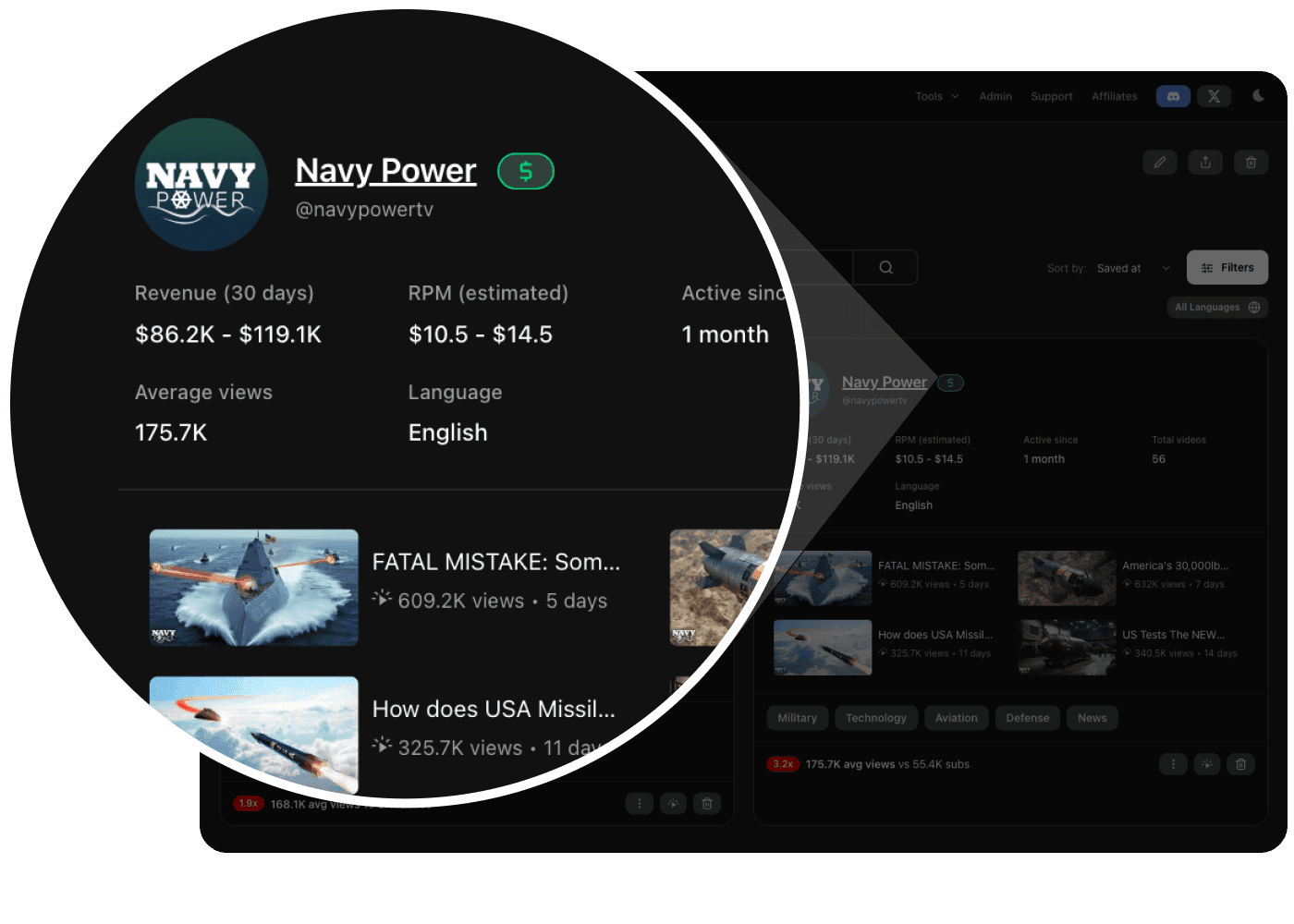
What TubeLab actually includes
TubeLab is more than one niche database. The platform connects several stages of YouTube strategy:
- Niche Finder: discover rising channels and potential unsaturated markets.
- Outliers Finder: find videos that dramatically outperform a channel's normal baseline.
- Trending Formats: study recurring title, topic, and packaging structures.
- AI Outlier Ideation: remix successful formats into original concepts.
- Niche Analyzer: estimate market size, saturation, audience behavior, and monetization potential.
- Rank Tracker: monitor YouTube search positions by keyword and country.
- MCP and API access: connect TubeLab data to AI assistants, n8n, or custom software.
- Free utilities: rank checking, niche analysis, monetization checks, and video data extraction.
The platform becomes most useful when these tools are used as a sequence. A creator can discover a niche, inspect breakout channels, study outlier videos, identify repeated title and thumbnail patterns, generate differentiated ideas, then track the search performance of published videos.
Niche Finder: TubeLab's core research product
The Niche Finder continuously monitors YouTube for newly successful channels and unusual growth patterns. TubeLab currently advertises access to more than 500,000 channels and says the database is updated every day. Users can filter by estimated RPM, revenue, monetization status, average views, content quality, faceless potential, language, category, channel age, and other performance indicators.
This is more useful than searching YouTube manually because search results are optimized for viewers, not market researchers. YouTube typically shows established content that already matches the searcher's history and location. TubeLab attempts to reorganize public channel data around business questions: Which new channels are growing? Which niches appear under-supplied? Which audiences may have stronger advertiser value? Which formats can be produced at a sustainable cost?
Revenue and RPM estimates need context
Estimated revenue and RPM are helpful for comparing opportunities, but they are not the same as verified creator earnings. Actual income changes by geography, season, video duration, ad inventory, viewer behavior, sponsorships, affiliate revenue, production cost, and YouTube policy. Use estimates to prioritize research, not to build a financial forecast without additional evidence.
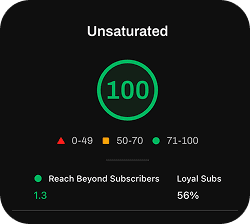
Unsaturated does not mean easy
A niche can appear unsaturated because audience demand is rising faster than supply, but success still requires strong packaging, retention, publishing consistency, and differentiation. The best opportunity is not simply the highest score. It is the niche where demand, monetization, production capability, risk, and creator knowledge overlap.
Outliers Finder: discovering videos that beat the baseline
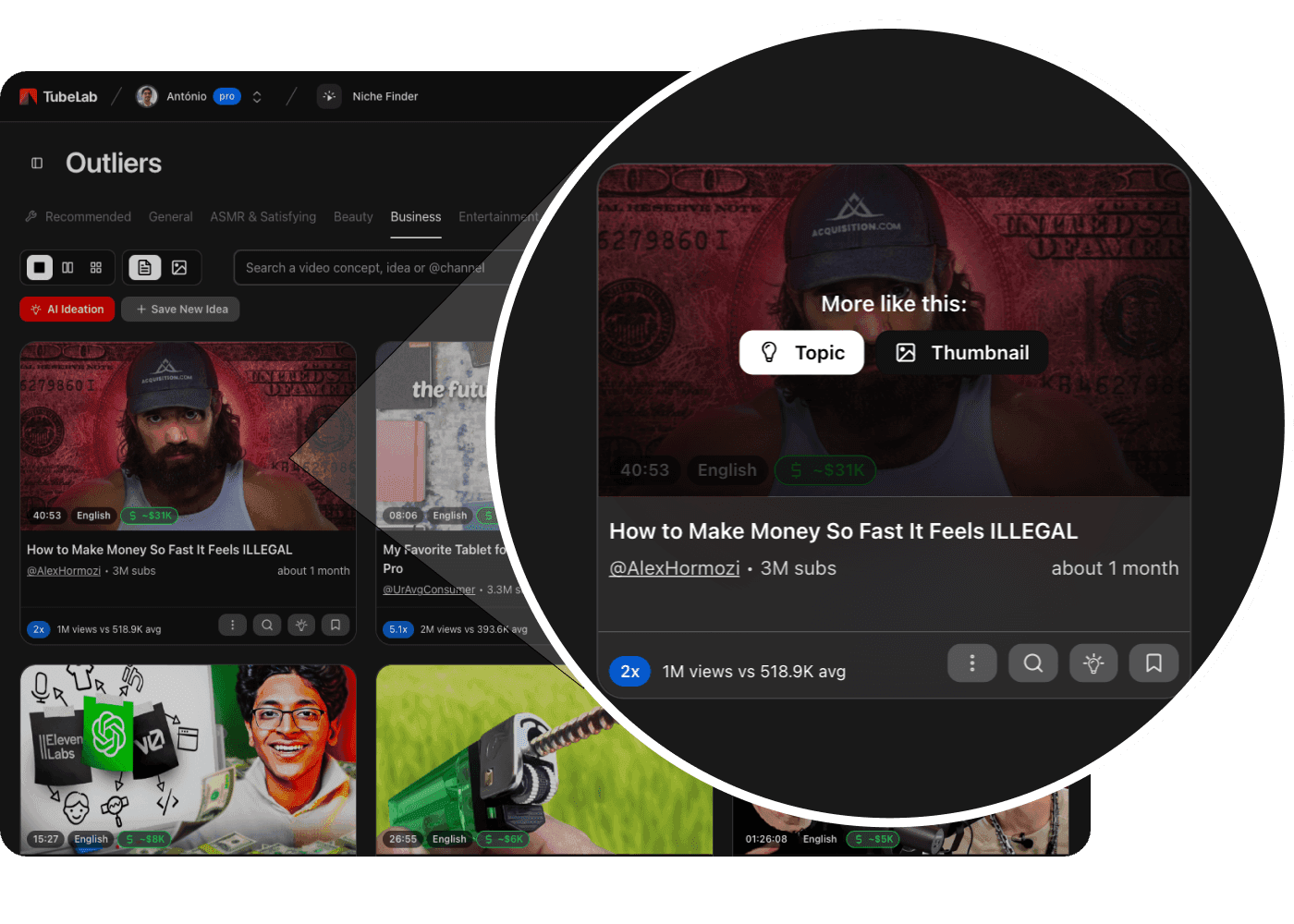
An outlier is a video that performs far above a channel's typical result. TubeLab's Outliers Finder searches for these exceptional videos across niches and presents their titles, thumbnails, view counts, channel context, estimated monetization signals, and outlier multipliers. The company says it has analyzed more than 400 million public videos to build a library of more than five million curated outliers.
The practical value is not copying a viral video. It is identifying the underlying structure: the promise, curiosity gap, emotional trigger, visual contrast, topic timing, format, and audience desire that made the video unusually effective. A useful outlier workflow asks three questions:
- What made the audience click?
- What made the idea relevant at that moment?
- How can the format be transformed rather than duplicated?
Advanced filters and similar-content discovery
TubeLab advertises more than 20 advanced filters for narrowing channels and outliers. Filters can help remove irrelevant results by language, niche, view range, revenue potential, channel size, publishing recency, faceless suitability, or content quality. This matters because a database with millions of records becomes useless when every search returns thousands of unrelated examples.
Similar-channel and similar-video discovery can be especially valuable. Instead of stopping at one competitor, users can expand outward to adjacent creators, topics, thumbnails, and formats. This helps reveal whether an apparent opportunity is a genuine market pattern or simply one exceptional channel.
AI Outlier Ideation
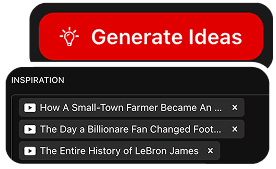
AI Outlier Ideation turns selected outliers into new video concepts. The difference from using a general chatbot is context: the ideation system begins with real videos and formats that have already performed. That can reduce blank-page friction and give creators a clearer starting point for titles, angles, and series concepts.
The risk is sameness. If many users generate ideas from the same visible outliers, the results may become repetitive. The strongest workflow adds proprietary context: your audience, expertise, story, production style, geographic market, and a specific promise competitors cannot easily reproduce.
Niche Analyzer: a fast second opinion
The free Niche Analyzer evaluates a topic using live data and attempts to estimate market size, saturation, monetization potential, and audience characteristics. It is useful before spending hours in the full database, especially when comparing several broad ideas such as personal finance, artificial intelligence, travel, history, gaming, or home improvement.
Scores should be treated as directional. A high score cannot see your production ability, credibility, budget, storytelling skill, or unique access to information. A lower-scoring niche can still be attractive when you have expertise, a strong brand, lower production costs, or a distinctive sub-niche.
Trending Formats and title-pattern research
TubeLab also organizes repeated title structures and video formats. Examples of formulas may include transformations, explanations, comparisons, challenges, timelines, rankings, or contrarian promises. Format research helps a creator understand how audiences prefer information to be packaged.
A formula is not a finished idea. Reusing the exact wording of a successful title can create weak imitation and audience fatigue. The goal is to identify why the structure works and apply it to a new subject with truthful, original value.
YouTube Rank Tracker
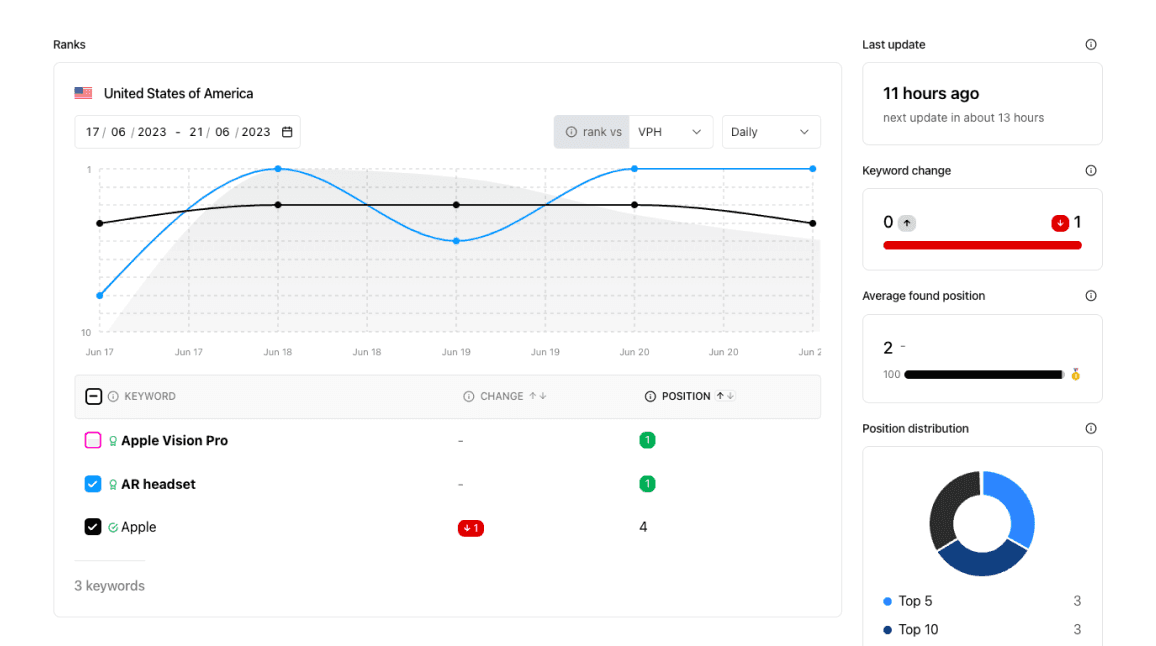
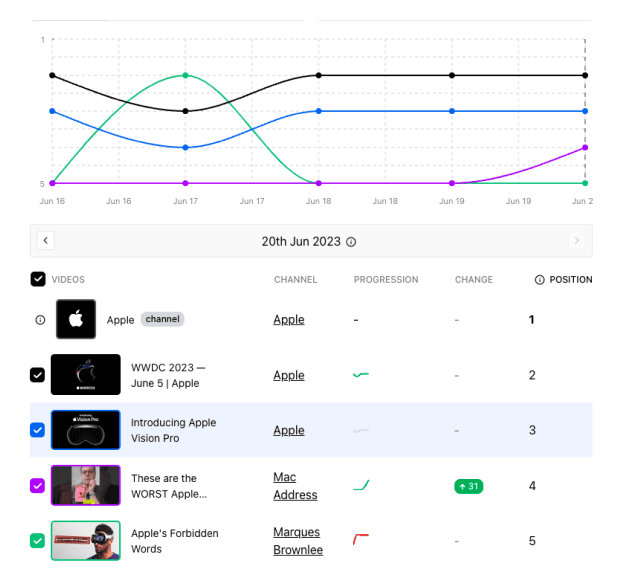
TubeLab's Rank Tracker monitors where a video appears for selected keywords and countries. The official product page says rankings are checked daily, supports more than 100 countries, provides access to the first 50 search results for competition analysis, and allows unlimited videos to be tracked for the same keyword and country. Users can export rank data to CSV or Excel.
Rank tracking is most useful for search-driven content such as tutorials, software comparisons, product reviews, educational answers, and evergreen how-to videos. It is less important for recommendation-led entertainment, where browse and suggested traffic often matter more than keyword position.
Competition analysis
The competition view displays other videos, channels, and playlists ranking for the same keyword. This makes ranking movement easier to interpret. A drop may reflect a competitor's new upload, changing search intent, stronger click-through rate, or a temporary event rather than a simple metadata problem.
Claude, ChatGPT, Codex, and MCP integration
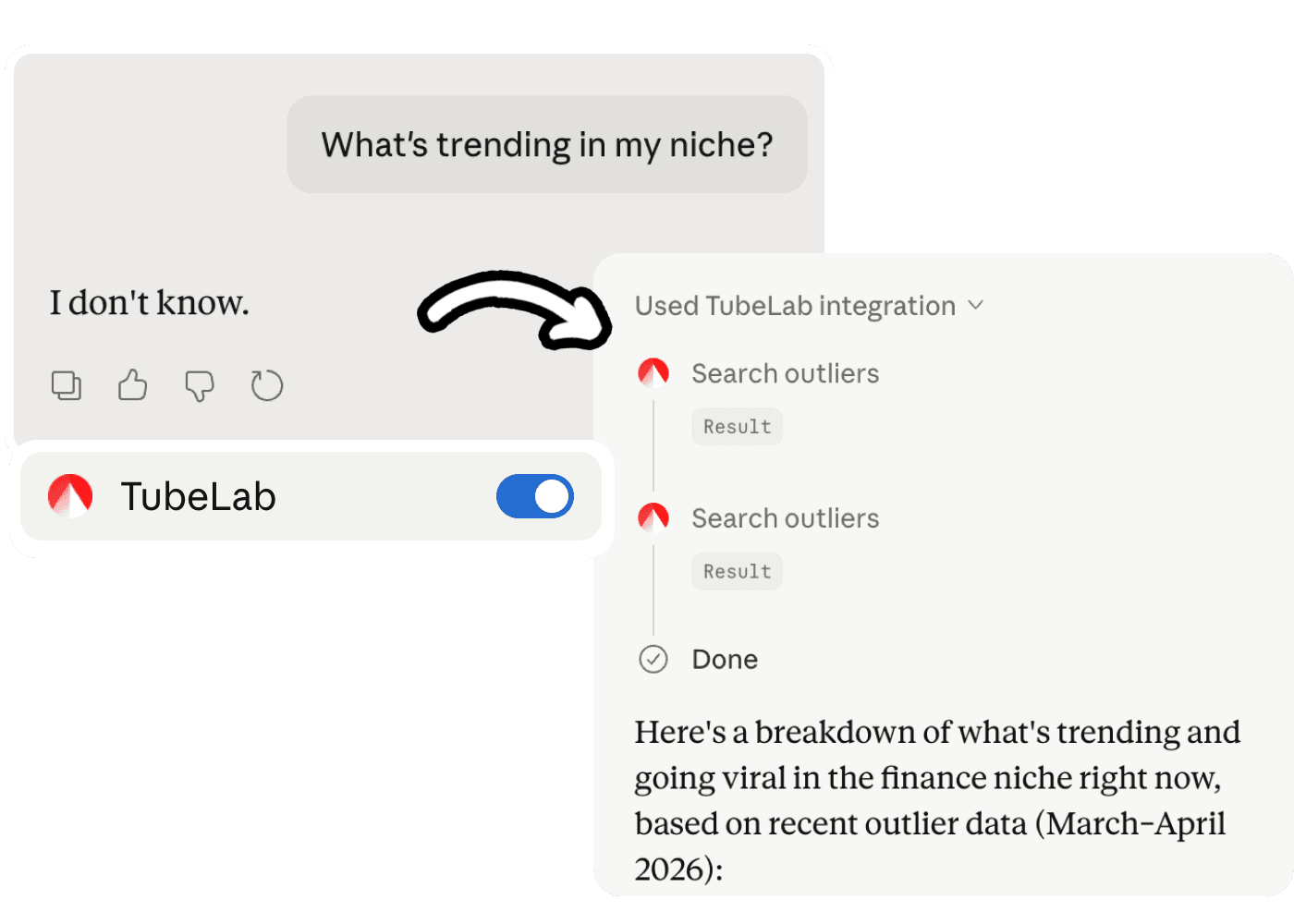
TubeLab offers a YouTube Data MCP that can provide live channel, outlier, transcript, and trend data to compatible AI tools. This can turn Claude, ChatGPT, Codex, Cursor, or another MCP client into a research assistant grounded in TubeLab's database rather than relying only on general model knowledge.
Possible workflows include asking an AI assistant to compare niches, summarize recurring outlier patterns, generate content briefs from current examples, inspect transcripts, or monitor emerging channels. The quality of the answer still depends on the prompt, retrieved records, and the user's ability to validate conclusions.
API and n8n automation
TubeLab's developer API exposes channel search, similar channels, outlier search, similar outliers, channel videos, shorts, video details, transcripts, comments, scanning, and credit-balance endpoints. An active subscription and available credits are required for API keys. The API documentation currently references more than 400,000 channels and four million outliers, updated daily.
For agencies and technical teams, API access can be one of TubeLab's strongest differentiators. It enables custom dashboards, automated competitor reports, niche alerts, client research, content pipelines, and n8n workflows. However, users should model credit consumption before building a high-volume automation because scans, AI actions, and API use may consume credits differently.
Pricing: monthly versus annual
TubeLab's own 2026 comparison pages publish a simple full-access structure: $29 per month when billed monthly, or $14.90 per month when billed annually, equal to $178.80 per year. The live pricing page displays monthly and yearly billing and currently advertises a $169 annual saving. Pricing, included credits, team limits, and promotions can change, so the checkout page should be treated as the final source before payment.
OptionPublished priceBest forMain consideration Free tools$0Testing rank checking, niche analysis, and selected utilities.Does not represent full Niche Finder and Outliers Finder access. Monthly$29/monthShort projects, evaluation, or creators avoiding annual commitment.Higher effective cost over a full year. Annual$14.90/month equivalentCreators and teams performing research every week.$178.80 is paid for the year; confirm renewal and credits first.Credits and usage planning
TubeLab's pricing FAQ separates normal subscriptions from a credits system. Credits are relevant to AI ideation, scanning, API operations, and other processing-heavy actions. The public pricing text available to us did not expose every current allowance, so buyers should confirm three numbers before subscribing:
- How many credits are included in the selected billing option?
- Which actions consume credits and at what rate?
- What happens when the account reaches zero credits?
A creator using the web interface for manual research may have different costs from an agency scanning many channels through the API.
Refund and cancellation terms
TubeLab's current terms describe a structured initial-purchase refund policy. A full refund may be requested within 24 to 48 hours, a 50% refund may be requested after 48 hours and within 15 days, and no refund is issued after 15 days. TubeLab also reserves the right to deny or reduce a refund when a substantial portion of included AI credits has been consumed. Recurring subscription renewals are non-refundable.
Subscriptions can be cancelled through the billing portal. Access remains active until the end of the current billing period, future charges stop, and the terms state that users retain access to their data after cancellation. These conditions are more specific than many SaaS refund pages, but they make it important to test the platform promptly after purchase.
Privacy and account data
TubeLab supports Google authentication. Its privacy policy says social login may provide the user's email address, name, and profile picture. The service may also collect account, device, usage, IP, location, browser, and interaction data. Payment information is handled through Stripe according to the published policy.
The policy also states that TubeLab may access permitted YouTube account data when users connect relevant services and that users can revoke Google or YouTube API access through Google security settings. Teams working with client channels should document who owns the account, which permissions are granted, and how access will be removed at the end of an engagement.
What TubeLab does well
- Focuses on opportunity discovery instead of only reporting historical channel statistics.
- Combines niche, channel, outlier, title, thumbnail, and monetization research.
- Updates discovery databases daily according to the product pages.
- Provides advanced filters for narrowing large datasets.
- Connects research to AI ideation instead of leaving users with raw data alone.
- Includes rank tracking and several free public tools.
- Offers API, n8n, and MCP options for sophisticated workflows.
- Publishes clear initial-purchase refund windows.
Where TubeLab needs improvement
- Database-size claims differ between the marketing website and API documentation.
- Revenue, RPM, saturation, and monetization figures remain estimates.
- A large outlier library can encourage copying unless users apply original judgment.
- Advanced filters require learning and can overwhelm beginners.
- Credit allowances and action costs should be reviewed carefully at checkout.
- It cannot measure your production quality, authority, audience trust, or creative execution.
- Recurring renewals are not refundable.
TubeLab versus other YouTube tools
NeedTubeLab fitConsider another tool when... Find emerging nichesExcellentYou only need analytics for channels you already know. Discover viral outliersExcellentYour priority is AI thumbnail generation rather than research depth. Basic keyword optimizationGoodYou want a beginner-focused browser extension and upload checklist. Historical channel statisticsGoodYou mainly need long-term subscriber charts across several social platforms. API and automationVery strongYou do not need custom systems or automated workflows. Full content productionLimitedYou need scripting, editing, thumbnail design, and publishing in one suite.Alternatives such as vidIQ, TubeBuddy, ViewStats, 1of10, NexLev, and Social Blade emphasize different parts of the creator workflow. TubeLab is most compelling when niche discovery and outlier research are the primary jobs.
A practical seven-day TubeLab test
- Day 1: define three niche hypotheses and the audience each one serves.
- Day 2: use Niche Finder filters to identify rising channels in each market.
- Day 3: save 20 to 30 relevant outliers and label the promise, format, and emotional trigger.
- Day 4: compare title and thumbnail patterns without copying them.
- Day 5: generate original concepts with AI Ideation and add your own expertise or perspective.
- Day 6: use the Niche Analyzer and external research to test monetization and production feasibility.
- Day 7: build a 10-video pilot plan and decide whether TubeLab saved enough research time to justify the subscription.
FAQ
Is TubeLab only for faceless YouTube channels?
No. Faceless creators are a strong use case, but the platform covers channels and outliers across many categories, including education, business, gaming, entertainment, technology, health, travel, and other creator-led formats.
Does TubeLab guarantee a profitable niche?
No. It can surface data and estimates, but profitability depends on content quality, audience demand, advertiser value, production cost, retention, monetization, and execution.
How often is TubeLab updated?
The official Niche Finder and Outliers Finder pages say the databases are updated every day.
Can TubeLab work with ChatGPT or Claude?
Yes. TubeLab offers MCP integrations designed to provide live YouTube research data to compatible AI assistants, along with an API for custom workflows.
Does TubeLab have free tools?
Yes. TubeLab publishes free utilities such as a rank checker, niche analyzer, monetization checker, and video data extractor. Full database access requires a paid subscription.
Can I cancel at any time?
The current terms say subscriptions can be cancelled through the billing portal and remain active until the end of the paid billing period.
What is the refund window?
The current terms describe a full refund request within 24 to 48 hours, a possible 50% refund from 48 hours through day 15, and no refund after 15 days. AI credit use can affect eligibility, and renewals are non-refundable.
Final verdict
TubeLab is a well-focused research product for creators who want to discover where YouTube attention is moving rather than only reviewing where their own channel has been. Its combination of Niche Finder, Outliers Finder, advanced filters, AI ideation, rank tracking, MCP, API, and automation creates a complete path from market discovery to content planning.
The platform earns 4.6 out of 5. It is a strong buy when YouTube research is a repeated business activity and one useful niche or video idea can justify months of subscription cost. It is a weaker purchase for occasional creators, users who dislike data-heavy workflows, or anyone expecting estimated revenue and outlier patterns to guarantee success.
The best buying decision is to begin with a defined niche question, test the free tools, purchase monthly if necessary, and evaluate whether TubeLab produces better decisions—not simply more saved videos—before moving to annual billing.
TubeLab Pricing and Access Options
| Product / Plan | Rating | Price | Top Highlights | Visit |
|---|---|---|---|---|
| Try FirstFree Tools | 4.8 | $0 | Niche AnalyzerYouTube Rank CheckerMonetization CheckerVideo Data Extractor |
Visit Site |
| FlexibleMonthly | 4.8 | $29/month | Full platform accessNo annual commitmentBest for testing a real workflowConfirm included credits at checkout |
View Pricing |
| Best ValueAnnual | 4.9 | $14.90/month equivalent | $178.80 billed annuallyPublished saving of about $169Best for weekly researchReview renewal and credit terms first |
View Pricing |
BUY: TubeLab is a strong buy for creators who perform structured YouTube research every week and can turn better niche and outlier data into original content decisions.
Users remain responsible for original content, intellectual-property rights, YouTube policy compliance, account permissions, data interpretation, and all business decisions made from estimated metrics.
Alternative path: Choose vidIQ or TubeBuddy for beginner upload optimization, ViewStats or Social Blade for different analytics priorities, 1of10 for packaging-focused ideation, or manual YouTube research when subscription cost matters more than time.
Explore TubeLab ↗What we verified
Official documentation, product terms, and current public information used in this review.
- Product type
- YouTube niche research, outlier discovery, and content intelligence platform
- Published monthly price
- $29/month
- Published annual price
- $178.80/year ($14.90/month equivalent)
- Advertised channel database
- 500K+ on the main website; 400K+ in API documentation
- Advertised outlier database
- 5M+ on the main website; 4M+ in API documentation
- Outlier source pool
- 400M+ public videos analyzed, according to TubeLab
- Rank tracking coverage
- 100+ countries
- Integrations
- MCP, API, n8n, Claude, ChatGPT, Codex, Cursor
- Editorial score
- 4.6 / 5
- Review method
- Official website, product pages, API docs, pricing, privacy, terms, and project media